
🌟 A Symphony of Creation, by Scott Acton
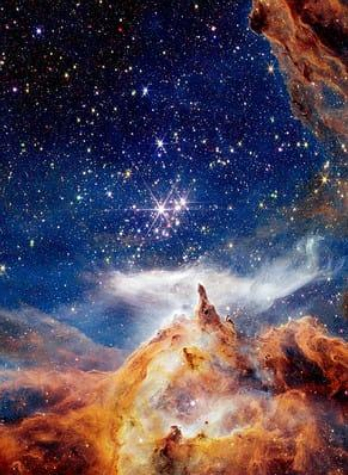
NGC 6357/Pismis 24 (Chandra/Webb)
I’d never worked so hard in my life. But that’s why we were there at the Space Telescope Science Institute. My team and I had been tasked with a formidable challenge: aligning the Webb Telescope shortly after it was launched into space. We needed to put all of its mirrors in precisely the right positions, so they would perform as one, creating a nearly perfect image. The precision required in this process was a handful of nanometers. Imagine if one of those 18 hexagonal mirror segments were the size of Texas. The precision we needed? A small ant hill.
I had personally spent the better part of 20 years working toward this moment. We had tried our best to imagine every possible scenario and to plan for every reasonable contingency. Even still, we encountered more than a few setbacks along the way. The stress of this task was taking its toll on me—on all of us, I suppose. Yet, a solution followed each new problem as, slowly, the telescope began to come into focus.
Several of us had the idea that if we pointed the telescope in the right location, and luck was on our side, we might see a galaxy, but I wasn’t remotely prepared for what we actually saw. One of the early images was taken using the Fine Guidance Sensor, which isn’t even designed to take science images. And that image was only taken as a placeholder—a 40-second exposure, so that the image buffer would be “flushed” into the main spacecraft memory. It covered a part of the sky that is the size of a grain of sand when held at arm’s length. But when I stretched the contrast on that image, I could see that it contained more than 500 galaxies! This telescope was going to change our understanding of the universe.
Walking home late that evening, I called my wife, Heidi, to tell her about the experience and what I had learned. “There are galaxies everywhere!” I cried. “They’ve always been there; we just couldn’t see them until now.” I must confess there were tears involved.
As I said goodbye, I gazed up into the night sky with a new understanding. My imagination began to take over. I pictured the sky full of galaxies, like a van Gogh painting. In my mind’s eye, I could see them—more than I could ever count. And the galaxies were singing!
I don’t know where I got the idea that the galaxies should sing. Perhaps it came from Madeleine L’Engle’s A Wrinkle in Time, a book that had quite an impact on me when I was a child. But upon subsequent reflection, I see that I am not the first person to have this idea. On the morning that Webb was launched into space, the NASA administrator Bill Nelson quoted Psalm 19:1, “The heavens declare the glory of God; the skies proclaim the work of his hands.”
Job 38:7 tells us that as Earth was being created, “. . . the morning stars sang together and all the angels shouted for joy.”
David also wrote in Psalm 148,
“Praise the Lord.
Praise the Lord from the heavens;
praise him in the heights above. . . .
Praise him, sun and moon;
praise him, all you shining stars.
Praise him, you highest heavens
and you waters above the skies.
Let them praise the name of the Lord,
for at his command they were created.”
Indeed, the galaxies were singing. And not in any language that a human could understand—they are galaxies, after all. But the emotion behind that music was clear. It was joy. The galaxies were expressing joy, because after all of these millennia, humanity could finally see them. Later, I would describe this experience this way: “We are surrounded by a symphony of creation. There are galaxies everywhere.”
Perhaps getting a glimpse into the scale of our universe should create a sense of insignificance and unimportance in us. There are probably a trillion galaxies—each with a hundred billion stars—that Webb could potentially see. Observing the heavens as a shepherd boy, David asked, “What is mankind that you are mindful of them, human beings that you care for them?” (Psalm 8:3–4).
Lent is the season when that question presses in closer. On Ash Wednesday we are reminded that God made us from the dust. We are small and brief. Galaxies burn for billions of years; we flicker for decades. In Lent, we sit with that reality instead of rushing past it.
And yet—I must confess I don’t ultimately mind being tiny. After all, the galaxies are singing! The universe is not merely large; it is legible. It can be known. We can study it, make discoveries, and worship the Creator of it all. In a season that calls us to repentance and humility, this is not a contradiction but a comfort. Our smallness does not mean meaninglessness. The God who called galaxies into being also fashioned minds capable of beholding them.
Lent reminds us we are neither sovereign nor self-made. We are dust breathed upon by God. Thus, we bow low in humility. Yet we also rejoice because the God who makes the galaxies sing is mindful of us! And so, when I look at images of distant galaxies, I do not feel erased. I feel invited to add my small voice to the chorus already underway.
NOTE: This was originally published 26 February 2026, written for the Reasons to Believe organization, reprinted here with permission from the author, my friend since 1983.